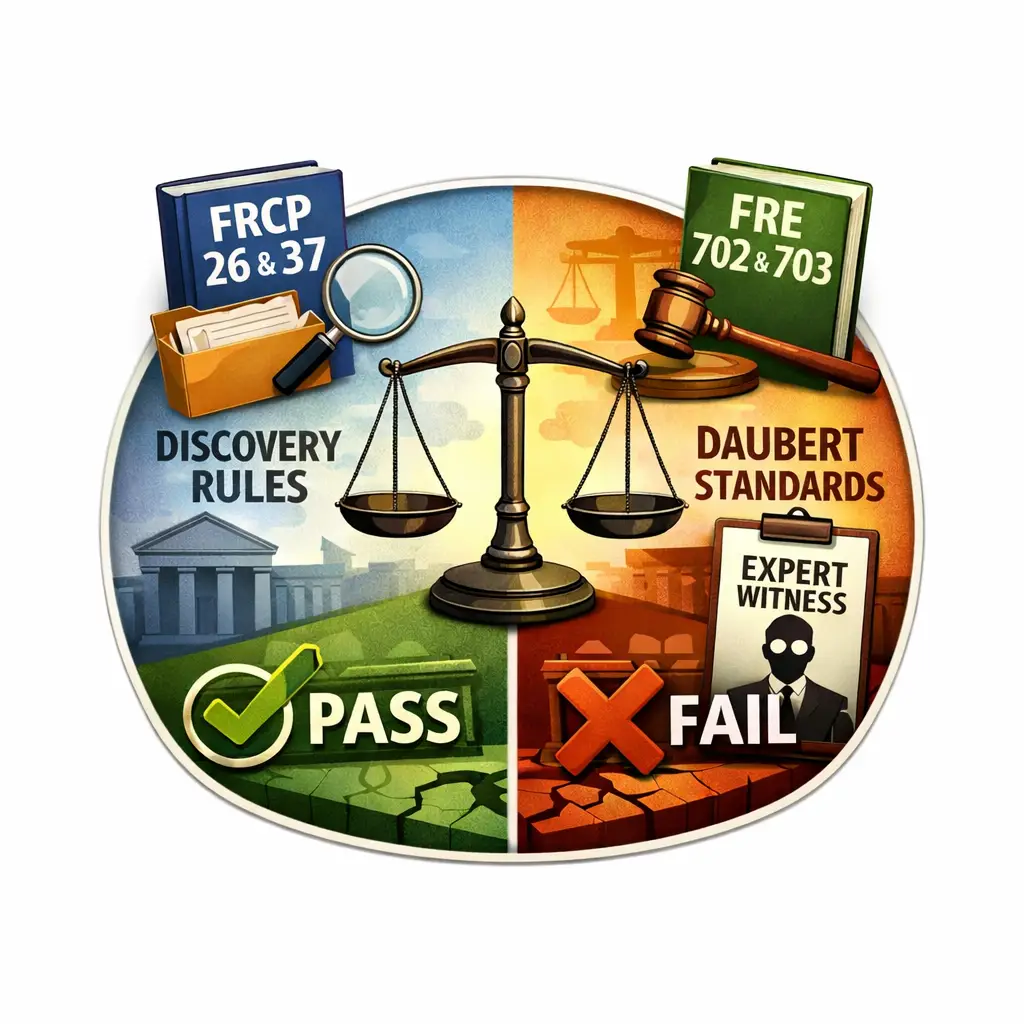
When expert testimony matters, two different rule sets control two very different things: the Federal Rules of Civil Procedure (FRCP) govern discovery, while the Federal Rules of Evidence (FRE) govern what actually reaches the jury. Confusing the two can be costly, especially with experts.
Procedural Rules vs. Evidentiary Rules
The FRCP are about how information is exchanged before trial. They regulate discovery: what must be disclosed, when, and in what form. Their central goals are fairness, efficiency, and avoiding surprise.
The FRE are about what information the judge or jury is allowed to consider at trial. They regulate admissibility: which testimony, documents, and other evidence can come in, and under what conditions. Their goals are reliability, relevance, and avoiding unfair prejudice.
Put simply:
- FRCP: “Did you play fair in discovery?”
- FRE: “Is this evidence reliable and helpful enough to be heard?”
You need to clear both sets of rules for expert testimony to survive.
FRCP 26 and 37: Discovery, Disclosure, and Sanctions
Rule 26 sits squarely in the discovery world. It does not decide whether an expert’s opinions are scientifically valid or helpful; instead, it dictates how those opinions must be disclosed so the other side can prepare.
For expert witnesses, Rule 26(a)(2):
- Requires identification of experts you may use at trial.
- Requires written reports for retained experts, including:
- A complete statement of all opinions to be expressed.
- The basis and reasons for each opinion.
- The facts or data considered.
- The expert’s qualifications, prior testimony, and compensation.
- Sets deadlines for these disclosures, usually via the scheduling order.
- Imposes a duty to supplement or correct disclosures that later turn out to be incomplete or incorrect.
The purpose here is fair notice. Rule 26 is designed to prevent “trial by ambush” by forcing parties to reveal their expert theories and foundations in advance.
Rule 37 provides the enforcement mechanism for discovery violations, including expert disclosure failures. It is still a procedural rule; it does not ask whether the expert’s science is sound, only whether the party complied with the procedural obligations.
Under Rule 37(c)(1):
- If a party fails to disclose an expert or required information under Rule 26, the default consequence is that the party cannot use that witness or information at trial, unless the failure was substantially justified or harmless.
- Courts can also impose additional sanctions, such as fees, issue preclusion, or even dismissal in severe cases.
So FRCP 26 and 37 operate at the discovery stage to shape and, if necessary, cut off expert testimony before admissibility is ever considered.
FRE 702 and 703: Admissibility, Reliability, and Daubert
Once an expert survives the procedural gauntlet of the FRCP, the focus shifts to the Federal Rules of Evidence, particularly Rules 702 and 703. These rules answer a different question: not “was this disclosed properly?” but “is this opinion reliable, relevant, and appropriate for the factfinder?”
Rule 702 is the main admissibility rule for experts. It requires that:
- The expert’s specialized knowledge will help the judge or jury understand the evidence or decide a fact in issue.
- The testimony is based on sufficient facts or data.
- The testimony is the product of reliable principles and methods.
- The expert has reliably applied those principles and methods to the facts of the case.
The Daubert standard comes from a line of Supreme Court cases interpreting Rule 702, starting with Daubert v. Merrell Dow Pharmaceuticals, Inc., 509 U.S. 579 (1993) (available at https://supreme.justia.com/cases/federal/us/509/579/). Those cases confirm that Rule 702 gives trial judges a gatekeeping role: they must screen expert testimony for relevance and reliability before the jury hears it.
Daubert emphasizes flexible factors such as:
- Whether the theory or technique can be and has been tested.
- Whether it has been peer reviewed and published.
- Known or potential error rates and standards.
- General acceptance in the relevant scientific community.
Recent amendments to Rule 702 also stress that the proponent must show, by a preponderance of the evidence, that these requirements are met.
Rule 703 complements 702 by dealing with the bases of an expert’s opinion:
- Experts may base opinions on facts or data they observed or were made aware of.
- Those facts or data do not have to be independently admissible if experts in the field reasonably rely on that kind of information.
- If those underlying materials are otherwise inadmissible, the court must decide whether revealing them to the jury would be more helpful than prejudicial.
Rule 703 does not change disclosure duties; it governs what may legitimately support an expert’s opinion once the expert is on the stand.
How the Purposes and Functions Differ
| Question | FRCP 26 & 37 (Discovery) | FRE 702 & 703 (Evidence) |
|---|---|---|
| Core purpose | Fair notice and orderly discovery | Reliability, relevance, and fairness at trial |
| Main focus | How and when information is disclosed | What the jury may hear and rely on |
| Stage of litigation | Pretrial discovery and case management | Pretrial motions in limine and trial |
| Key consequence | Exclusion or limitation as a sanction | Exclusion or limitation as inadmissible evidence |
| Primary question | Did you follow disclosure rules? | Is the opinion reliable, helpful, and well-grounded? |
| Driven by | Procedural fairness | Substantive truth-seeking |
How the Two Sets of Rules Impact Expert Testimony
In practice, these two systems operate sequentially but also reinforce each other.
- Discovery stage: FRCP controls who and what gets to trial
- If an expert is not properly disclosed under Rule 26, or if their report is incomplete or late, Rule 37 may bar that expert or parts of their opinion altogether.
- This can happen even when the expert’s methodology would otherwise satisfy Daubert. The testimony never gets far enough for a Rule 702 decision because it was not properly disclosed.
- Pretrial admissibility: FRE controls what the jury hears
- After adequate disclosure, the opposing party often challenges admissibility under Rule 702 (Daubert) and, where relevant, Rule 703.
- The court decides whether the disclosed opinions are based on sufficient data and reliable methods and whether the expert has applied those methods appropriately.
- Trial: both sets of rules still matter
- If an expert strays beyond the scope of the disclosed opinions at trial, opposing counsel can object that the testimony exceeds Rule 26 disclosures and move to strike it.
- If the expert offers opinions that conflict with the court’s prior Daubert ruling, that testimony can also be excluded or stricken as inadmissible under the FRE.
- The net effect is a two-gate system:
- Gate 1 (FRCP): “Were the expert and their opinions properly disclosed in discovery?”
- Gate 2 (FRE/Daubert): “Are those opinions reliable and appropriate for the jury or fact finder?”
- Fail either gate, and key testimony may be limited, excluded, or stricken altogether.
A Practical Illustration: Forensic Signature Expert
Imagine a case where the central issue is whether a signature on a personal guaranty is genuine. The plaintiff retains a forensic signature expert.
- Discovery failures (FRCP)
The expert is disclosed late. His Rule 26 report simply concludes that “the signature is almost certainly not genuine,” without laying out the comparison techniques used, reference samples reviewed, or any discussion of error rates or standards. The court finds the disclosure violates Rule 26 and, under Rule 37, limits or excludes the expert’s testimony because the incomplete report deprived the defense of fair notice. - Admissibility failures (FRE)
Even if the court allows some testimony despite the late disclosure, the defense files a Daubert motion under Rule 702. The judge concludes the report does not show that the expert used sufficiently reliable methods or applied them reliably to the disputed signature. The expert’s conclusions are excluded as inadmissible, even though the disclosure issue has already been addressed.
By the time trial begins, procedural and evidentiary rules have combined to silence an expert who might have seemed impressive on paper. The FRCP controlled whether the testimony got to the courtroom; the FRE controlled what the jury could hear once it did.
Takeaways for Practice
For lawyers, the key is to respect both systems at once:
- Treat FRCP 26 as defining the outer boundary of what your expert can say at trial; anything not fairly disclosed is at risk.
- Assume Rule 37’s exclusion sanction is real; do not rely on the court to excuse missed deadlines or incomplete reports.
- Build your expert presentation with Rule 702 and Daubert in mind from day one, and make sure the report itself demonstrates the data, methods, and reasoning, not just the bottom-line conclusion.
- Remember that Rule 703 does not fix a bad report or bad methods; it simply tells you what kinds of underlying information the expert may reasonably rely on and when that information can be shared with the jury.
When you keep the FRCP’s discovery function and the FRE’s admissibility function distinct—but coordinated—you give your expert the best chance of both reaching the stand and staying there.
Discover more from A Lawyer In Florida
Subscribe to get the latest posts sent to your email.