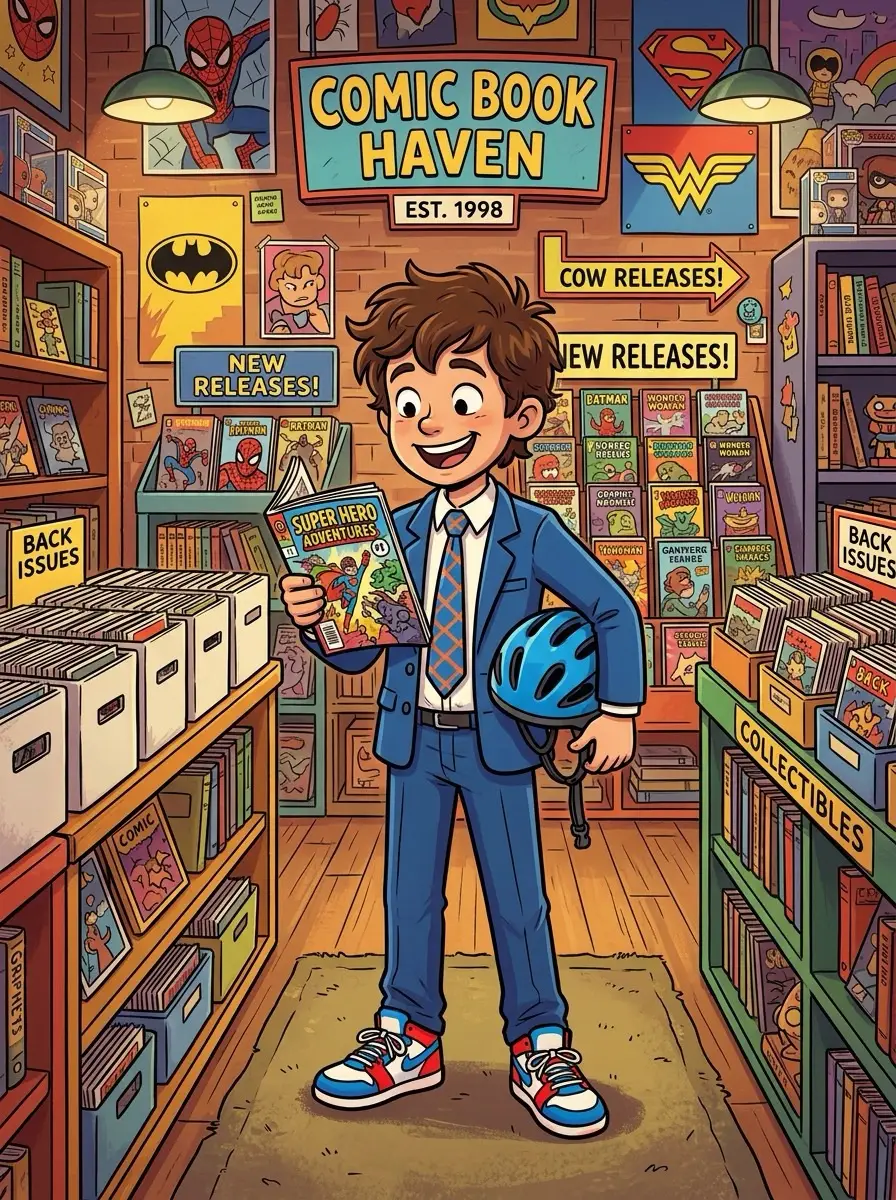
When I was a kid every Friday after school I biked down to my local comic shop and spent my allowance on whatever had been released that week. When I got home, I would drop onto my bed and get lost in stories about outcasts who protected even the people who feared them; a teenager wracked with guilt and struggling with the responsibility that had been thrust upon him; a sickly young man from Brooklyn who became a star-spangled freedom fighter; a dark knight who prowled the streets trying to spare others the tragedy he suffered as a child; and a godlike alien from another world, adopted and raised by salt of the earth Americans, whose greatest power was his humanity.
Back then, I thought comic books were just stories. Only much later, after becoming a lawyer, did I come to appreciate that they were also contracts, copyrights, assignments, termination notices, and hard-fought ownership disputes.
A great many of the characters and stories that defined my childhood were created under “work made for hire” arrangements, a doctrine reflected in 17 U.S.C. § 101 and 17 U.S.C. § 201(b), under which the employer or commissioning party, rather than the individual creator, can be treated as the legal author.
That realization changes the way I look at the medium. The history of comic books is not just a history of creative brilliance; it is also a history of talented people creating enormous value that they often did not own. In many cases, the creators could not possibly have imagined the full scope of what they were signing away. They were not just giving up the right to publish words and pictures on cheap paper. They were also surrendering the future exploitation of ancillary rights that would one day include action figures, toys, video games, licensing deals, fast-food promotions, film adaptations, television franchises, and even stage productions. Spider-Man made it to Broadway in Spider-Man: Turn Off the Dark, and Superman did too in It’s a Bird… It’s a Plane… It’s Superman.
The Superman story is the classic example. Jerry Siegel and Joe Shuster transferred rights in Superman early on, and the ownership fight later unfolded across decades of litigation involving statutory termination and recapture efforts by heirs. Those disputes arose because the Copyright Act gives authors and, in some circumstances, their heirs the power to terminate earlier grants under 17 U.S.C. § 203 and 17 U.S.C. § 304, subject to detailed timing and notice requirements administered by the Copyright Office.
Marvel’s history produced a similarly important line of cases. In Marvel Characters, Inc. v. Kirby, 726 F.3d 119 (2d Cir. 2013), the Second Circuit held that the works at issue were made for hire under the 1909 Act’s “instance and expense” test, which meant Jack Kirby’s heirs could not exercise termination rights as to those works. The decision reinforced how powerful the work-for-hire doctrine can be when a publisher successfully characterizes the relationship that way.
Another major dispute involved Captain America. In Marvel Characters, Inc. v. Simon, 310 F.3d 280 (2d Cir. 2002), the Second Circuit addressed Joe Simon’s attempt to terminate an earlier grant and held that a later agreement retroactively labeling the work as made for hire could be an “agreement to the contrary” that could not extinguish statutory termination rights. That case matters because it shows that parties cannot always draft around the statute after the fact.
By the late 1980s and early 1990s, the business side of comics was harder to ignore. A new generation of superstar creators — Todd McFarlane, Jim Lee, Rob Liefeld, Erik Larsen, Marc Silvestri, Jim Valentino, and others — became brands in their own right, and fans increasingly followed creators as much as characters. Their frustration was not merely about page rates or creative control. It was about ownership, and specifically about why they should continue building valuable intellectual property for the Big Two (Marvel and DC) under work-for-hire structures while publishers captured the long-tail value across media and merchandising.
That frustration helped give rise to Image Comics in 1992. Image was not just a publishing startup; it was a structural response to the ownership problem. Its founding premise was that creators could retain ownership of the characters and worlds they created, rather than defaulting into the work-for-hire model that had dominated mainstream superhero publishing for decades. In practical terms, that meant the creators, rather than the publisher, stood to benefit from later exploitation through licensing, adaptations, and other downstream uses.
From a legal perspective, that was the real lesson. Instead of spending years litigating over whether old work qualified as made for hire, the next generation tried to solve the issue on the front end through contract structure and ownership retention. That shift did not eliminate disputes, but it changed the bargaining conversation. It also pushed larger publishers to offer better terms in some settings, including royalties, credits, and limited participation in exploitations beyond the printed comic itself.
Looking back now, the comics I loved as a kid have not lost their magic. But they do look different. I still see the heroism, imagination, and mythmaking. I also see the legal architecture underneath: the definitions section, the assignment clause, the reservation-of-rights language, the termination notice, and the litigation caption.
The practical lesson extends well beyond comic books. The evolution of work-for-hire law and the cases that shaped the industry underscore how much turns on the language of the contract signed at the outset. A provision stating that what you create will be a work made for hire, or alternatively that all rights are assigned exclusively to the employer or commissioning party, may transfer not only immediate publication rights but also the full future value of the work, including uses nobody can yet foresee. Even where the bargaining position is weak (as it was for many of the titans of the Golden Age) consulting a lawyer before signing at least allows a creator to make an educated decision about whether the deal is worth it under the circumstances. The law cannot always create leverage where none exists, but it can provide clarity, and clarity is often the difference between informed consent and a lifetime of regret.
Discover more from A Lawyer In Florida
Subscribe to get the latest posts sent to your email.