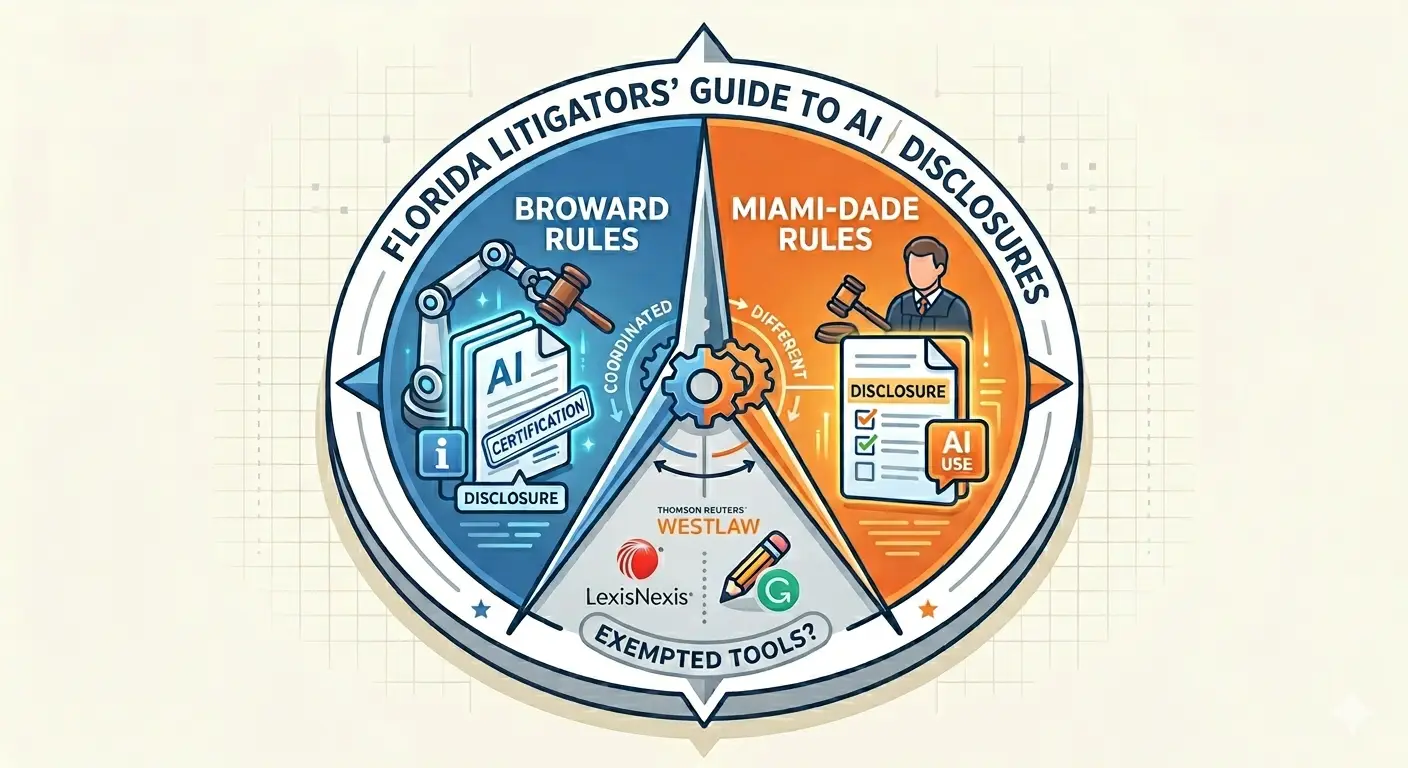
Florida trial courts are moving quickly to regulate generative AI in litigation. Broward’s AO 2026-03-GEN (Amendment 2) and Miami-Dade’s AO 26-15 (rescinding AO 26-04) both require disclosure when generative AI is used to draft or generate filing content, require a verification certification, impose a duty of candor and personal review, and create explicit sanctions for noncompliance.
Both Orders exclude “traditional” use of AI legal research tools like Westlaw and Lexis from the reporting requirements, excluding them from the definition of “generative AI”.
Disclosure is not required when using AI legal research platforms solely for routine
research purposes, or for retrieving authorities or cite-checking. Disclosure is also not required when generative AI tools are used solely for grammar, spelling, or clarity edits, provided the substance and content of the filing is drafted and verified by the filer.
However, the line between traditional legal research using Boolean logic and natural language to search databases containing case law, statutes, secondary sources, and practice tools/forms has begun to blur with the introduction of deep AI legal research tools. The current iterations of Westlaw and Lexis’ premier platforms blend different types of AI, including generative AI, to synthesize text, draft documents, and construct answers, rather than just retrieve information from vast databases.
This technology begs the question: are deep AI-generated legal research summaries a form of generative AI, even if the intended use was “routine research purposes”? I propose that they are to the extent that a user does not merely review the cited cases or authorities and, instead, relies on or borrows the summaries directly. While the intended purpose may be for “routine research purposes”, the detailed summaries generated by deep AI research provide an analysis of the results, and the incorporation of those summaries in any court filings clearly falls within the bounds of generative AI and requires reporting.
The two circuits are no longer operating under materially different disclosure regimes. Formerly, Broward County required identification of the specific generative AI tool employed by the lawyer.
The strongest remaining distinctions are structural and historical. Broward’s amended AO recites that it is coordinated with Miami-Dade’s AO 26-15, while Miami-Dade expressly states that it vacates and supersedes AO 26-04.
Comparing the Orders
| Issue | Broward AO 2026‑03‑GEN (Amendment 2) | Miami‑Dade updated AI order (26‑15) |
|---|---|---|
| Core requirement | Requires attorneys and pro se litigants who use AI to assist with preparation, researching, drafting pleadings, reviewing pleadings, drafting or reviewing documents, filing documents, reviewing discovery, or preparing discovery requests to exercise human oversight (checking citations, verifying factual claims, analyzing conclusions) and to disclose and certify AI use when generative AI is used in filings. | Requires attorneys and self‑represented litigants who use generative AI to draft or generate content used in a pleading, motion, memorandum, response, proposed order, or other court filing or record to disclose that use and include a certification that they have read and verified the accuracy of citations and AI‑drafted language. |
| Scope | Expressly states that AI may be used to assist in preparation, research, drafting and reviewing pleadings and documents, filing documents, reviewing discovery, and preparing discovery requests; its mandatory disclosure provision covers generative AI used in all of those tasks as well as preparation of proposed orders and “any other court documents.” | States that AI may be used to assist in preparation, research, drafting and reviewing pleadings and documents, filing documents, reviewing discovery, and preparing discovery requests, but the mandatory disclosure section is triggered when generative AI drafts or generates content used in pleadings, motions, memoranda, responses, proposed orders, or other court filings or records. |
| Identification of AI tool | Defines “Generative AI” in detail and lists specific examples (Harvey AI; Lexis+AI; AI.Law; Co‑Counsel; Westlaw drafting assistant; ChatGPT; Google Gemini; Microsoft Copilot; Claude AI), and requires that filings or submissions containing AI‑generated content disclose the use of AI and include the specified certification, but does not separately require naming the particular tool by brand in the certification clause itself. | Uses the same “Generative AI” definition and examples and requires disclosure that generative AI was used in preparing the submission, together with the same model certification language, but likewise does not separately require that the specific tool be identified by name in the certification text. |
| Treatment of legal research and grammar tools | States that “AI tools for legal research, drafting documents, and assisting in the discovery process must be consistent with Florida law, court rules of procedure, the rules governing professional responsibilities, and the obligation to protect confidential information,” and then provides that disclosure “is not required when using AI legal research platforms solely for routine research purposes, or for retrieving authorities or cite‑checking,” and that disclosure is not required when generative AI tools are used “solely for grammar, spelling, or clarity edits,” provided the filer drafts and verifies the substance and content. | Contains the same carve‑outs in its “Mandatory Disclosure of Generative AI Use” section: disclosure is not required when AI legal research platforms are used solely for routine research, retrieving authorities, or cite‑checking, and disclosure is not required when generative AI tools are used solely for grammar, spelling, or clarity edits, so long as the substance and content of the filing is drafted and verified by the filer. |
| Certification language | Requires filings where generative AI was used to include a certification that generative AI was used in preparation of the submission and that the filer “has read and verified the accuracy of every citation to the law and/or the record, and the accuracy of any language drafted by the generative artificial intelligence, including quotations, citations, paraphrased assertions, facts, and legal analysis,” and accepts full responsibility; this certification may be placed at the conclusion of the submission or above the signature block. | Uses the same certification text, stating that submissions described in the order “must include a statement substantially in the following form” with identical language, and likewise allows placement at the conclusion of the submission or above the signature block. |
Why This Matters
The updated orders materially reduce the significance of any prior circuit split. Both orders now use the same substantive framework for disclosure, verification, prohibited conduct, and sanctions, and both expressly exempt routine legal research and limited grammar or clarity edits from mandatory disclosure.
Broward’s AO 2026-03-GEN (Amendment 2) and Miami-Dade’s AO 26-15 require disclosure of generative AI use, not disclosure of the product name. Both orders list examples of generative AI programs, but neither requires the filer to identify the specific tool used in the disclosure or certification text.
Final Thoughts
A stigma remains over the open deployment of generative AI tools. While the legal profession is working to adopt AI tools in an ethical way that supports zealous and efficient representation, some attorneys remain reluctant to acknowledge their use, as though doing so diminishes either the practice or the practitioner. As legal norms develop, forward-looking lawyers will treat this technology as another tool in the legal arsenal rather than something to hide.
The certification requirement is not intended to shame lawyers. Instead, it is designed to: (a) provide transparency to the court about qualifying AI use so the court is not forced to ferret out hallucinations and other misuse in every filing; and (b) keep users of generative AI honest by requiring them to affirmatively verify AI‑generated results or face potential sanctions.
In this regard, caution may dictate including the certification where deep AI legal research has been used and the resulting explanations incorporated into a court filing.
Discover more from A Lawyer In Florida
Subscribe to get the latest posts sent to your email.