Involuntary bankruptcy can be the nuclear option for a creditor facing nonpayment and disappearing assets. It can disrupt a business and restrict other creditors’ collection efforts. Sometimes that intervention is justified. Using it simply to increase payment pressure can leave the creditor owing money.
Who Qualifies to File?
11 U.S.C. § 303 permits involuntary Chapter 7 and Chapter 11 cases against eligible debtors, excluding farmers, family farmers, and qualifying nonprofit corporations. Ordinarily, 12 or more qualifying creditors require three petitioners; fewer than 12 may permit one. Statutory exclusions affect the count.
Petitioning claims cannot be contingent as to liability or subject to a bona fide dispute over liability or amount. Aggregate qualifying claims must exceed their collateral’s value by at least $21,050, effective April 1, 2025.
A contingent debt requires an event before liability arises. A guaranty conditioned on default may be contingent before default. That differs from an existing debt not yet due. Review contracts, defenses, payment records, and guarantees before treating a claim as eligible.
Similarly situated creditors can share payment experiences, asset information, and investigative costs. Working together may strengthen the assessment, but sharing expenses does not eliminate anyone’s exposure.
A Contested Petition Requires Proof
Under Bankruptcy Rule 1011, the debtor ordinarily has 21 days after service of the summons to respond. Opposition can lead to discovery and trial.
Under section 303(h), creditors ordinarily must prove that the debtor is generally not paying debts as they become due, excluding genuinely disputed debts. Certain recent custodial appointments supply an alternative ground. An uncontested petition results in an order for relief.
Management May Remain During the Gap Period
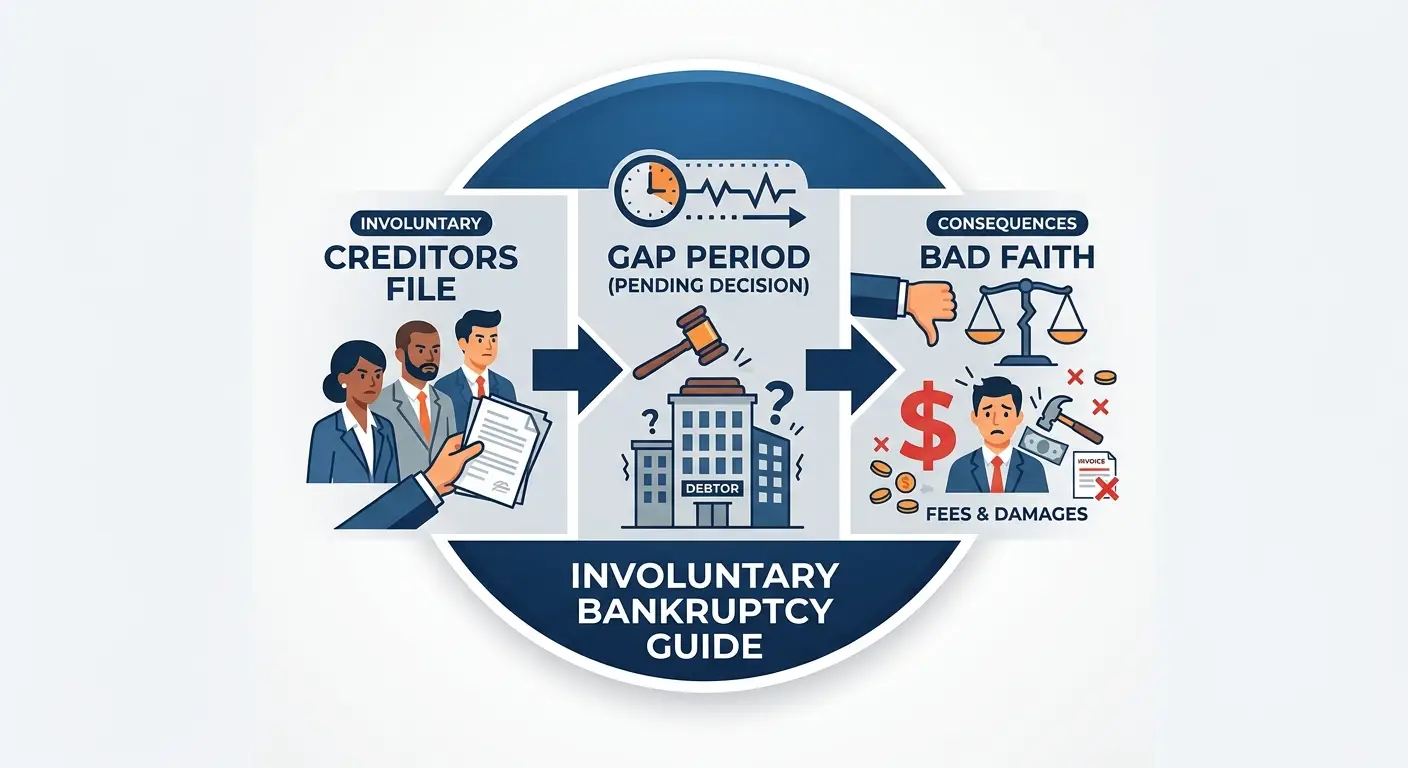
The gap period runs from filing until an order for relief. The automatic stay generally begins upon filing under section 362(a). Yet section 303(f) generally permits continued operations and property transactions unless the court orders otherwise. Creditors may be stayed while management remains in control.
If assets face danger, request protection. In Chapter 7, section 303(g) permits an interim trustee when necessary to preserve property or prevent loss, after notice and a hearing. Filing alone does not install one.
Payments also require care. Section 549(b) protects gap-period transfers exchanged for qualifying new value. Payment of old debt does not supply that value and may face later recovery.
A Valid Judgment Does Not Justify Every Tactic
In Wilk Auslander LLP v. Murray (In re Murray), 900 F.3d 53 (2d Cir. 2018), a creditor pursuing more than $19 million targeted a cooperative apartment owned by the debtor and his wife. Bankruptcy offered a potential sale of the entire apartment rather than execution against only the debtor’s interest.
The Second Circuit affirmed dismissal under section 707(a). There were no competing creditors to protect, no threatened asset depletion, and adequate state remedies. The court assumed filing eligibility but rejected bankruptcy as another battlefield for a two-party dispute. It did not find bad faith.
Bad faith carries additional risk. Under section 303(i), a qualifying dismissal can expose petitioners to fees and costs without bad faith. Bad faith can add damages caused by filing and punitive damages.
In Rosenberg v. DVI Receivables XIV, LLC, 818 F.3d 1283 (11th Cir. 2016), evidence included using bankruptcy instead of ordinary collection and pressuring payment from a trust. A jury found bad faith and awarded $6.12 million. The Eleventh Circuit reinstated the award on procedural grounds without deciding evidentiary sufficiency.
Investigate first. Confirm eligibility, examine the debtor’s broader payment history, and identify what bankruptcy would accomplish beyond collecting your debt. An aggressive filing without that groundwork may turn the creditor into a defendant facing substantial liability.
Discover more from A Lawyer In Florida
Subscribe to get the latest posts sent to your email.