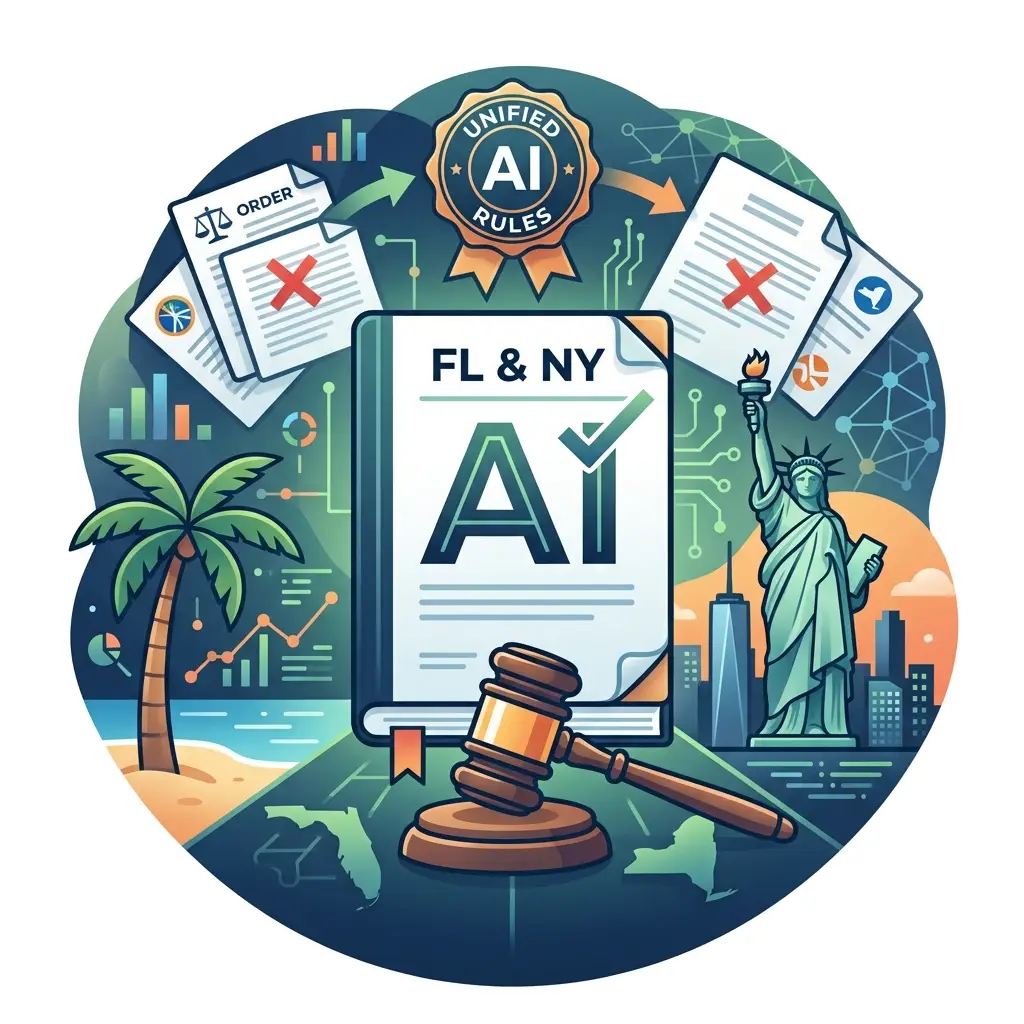
In my earlier post, I wrote about the administrative orders recently issued in Broward and Miami-Dade and the very real concern they were trying to address: filings built on AI output that had not been checked carefully enough. Florida has now moved beyond that patchwork approach, and the Florida Supreme Court has made clear that statewide rulemaking, not local experimentation, is the path forward.
Florida Ends the Patchwork
The Florida Supreme Court has amended Rule 2.515(d)(2), effective June 15, 2026, to require that the signer of a filing represent that “the legal authorities identified exist and are accurately cited”. In its commentary, the Florida Supreme Court said,
2026 Amendment. The Court adopted the 2026 amendments to subdivision (d)(2) principally to create a statewide, uniform replacement for varied circuit court administrative orders imposing disclosure and certification requirements about the use of artificial intelligence in filings…
I construe this to mean that local courts may not impose their own certification requirements on top of the statewide rule. That is the real shift.
The new rule does not create a special AI regime so much as it puts the burden back where it belongs, on the lawyer who signs the paper. You can read the operative Florida rule and court opinion adopting the rule here.
New York Takes Its Own Route
New York adopted its own statewide AI rule around the same time, effective June 1, 2026, through Part 161. While the structure is a bit more explicit than Florida’s, the underlying approach is aligned. The rule permits AI use in preparing papers submitted to the court without need for any affirmative disclosure of AI use, but it requires lawyers to carefully review the submission and independently ensure it does not contain fabricated cases, statutes, or other material.
Unlike Florida, New York did not make disclosure the centerpiece. The focus is closer to basic lawyering: know the tool, verify the output, and do not sign your name to something you have not checked. You can read the operative New York rule here.
What Changed
The early local orders in places like Broward and Miami-Dade were understandable, but they were also a stopgap. They responded to the immediate problem of hallucinated citations and unchecked AI drafting by adding mandatory disclosure and certification requirements. The statewide rules in Florida and New York take a more measured approach, using existing ethical duties as the backbone instead of building a separate compliance layer.
That matters for lawyers practicing across multiple courts. A uniform rule is easier to follow, easier to explain to clients, and harder to trip over by accident. It also reflects the broader reality that AI is not going away. Consequently, the courts are trying to regulate the lawyer’s conduct, not the technology itself.
What Lawyers Should Take Away
The practical lesson is simple. AI can help with drafting and research, but it cannot relieve lawyers of the duty to verify facts, citations, and legal analysis before anything gets filed. The name on the signature block still means the same thing it always did: you own the paper.
That is where this is headed. The rules are changing, but the core expectation has not. Lawyers are still expected to use judgment, supervise the work, and make sure the filing is accurate before it leaves their desk.
Discover more from A Lawyer In Florida
Subscribe to get the latest posts sent to your email.