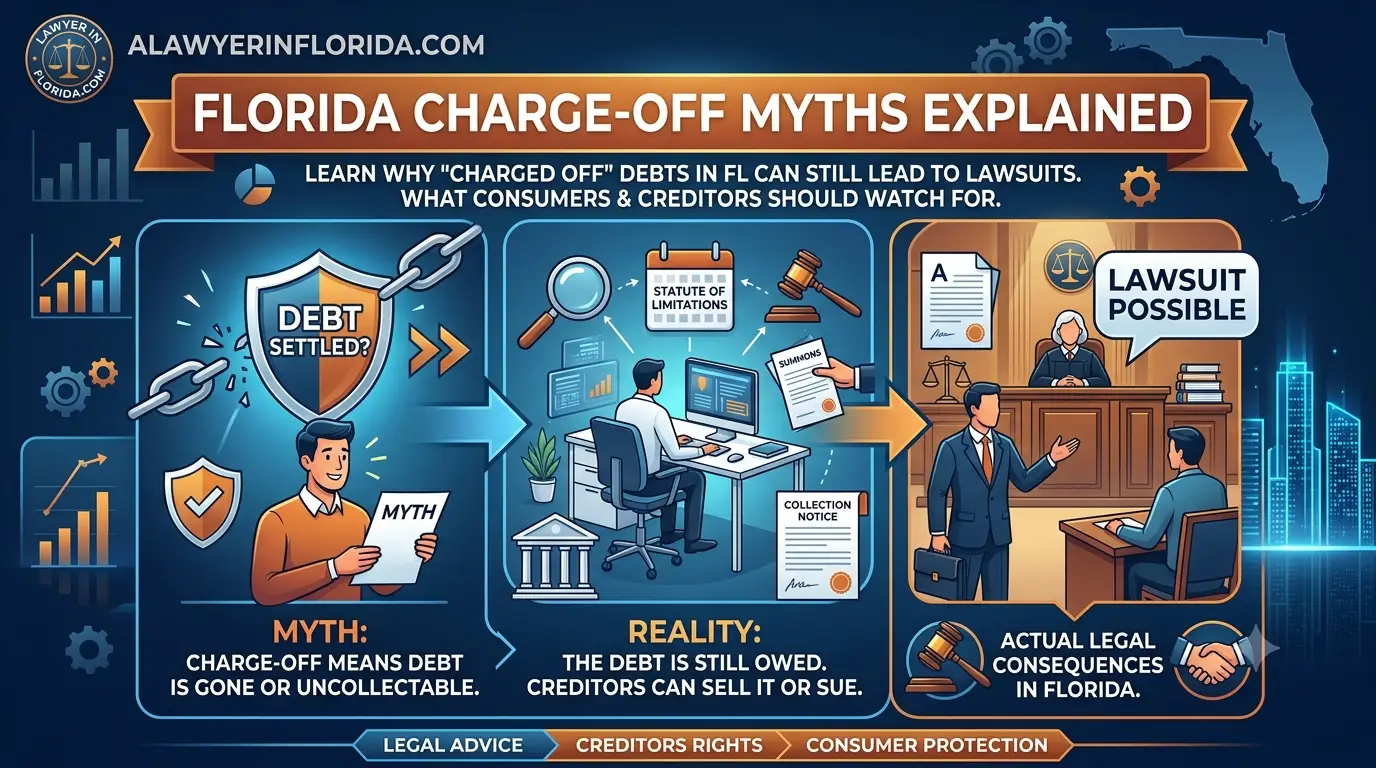
Most people see “charge-off” on a credit report and think the debt has disappeared. In Florida, that is almost never true. The Federal Reserve describes charge-offs as loans removed from a lender’s books and charged against loss reserves. That means charge-off is a bookkeeping event, not legal forgiveness of the debt.
In plain English, the lender may treat the account as a loss for accounting purposes while still claiming the right to collect it. That is why the words “charged off” can confuse both consumers and creditors.
What charge-off really means
When a lender charges off a credit card or other consumer account, it is usually saying the account is seriously delinquent and no longer performing.
US Bank describes a “charge-off” is an accounting term which means the creditor believes a debt (money owed) can’t be collected. This can be due to things like:
- An account being past due for months.
- An agreement not to collect a certain amount due.
- A settlement agreement was not completed.
These amounts are reported to credit reporting agencies. It may appear on credit reports, as charged-off debt is still owed. A creditor may still look to collect it unless a settlement agreement is reached and successfully completed. The debt may still be collected, sent to a collection agency, sold to a debt buyer, or turned over to a lawyer for suit.
What charge-off does not mean:
- It does not automatically erase the debt.
- It does not stop a lawsuit.
- It does not reset the statute of limitations.
The legal obligation usually continues unless something else happens, such as a settlement, bankruptcy discharge, or expiration of the limitations period.
Why old debt can still lead to a lawsuit
One of the biggest myths is that a charged-off account is too old to sue on. Sometimes that is true, but often it is not. The important date is usually not the charge-off date. It is the date of default, acceleration, or some other event that triggered the claim.
That matters because accounts are often charged off months after the borrower stopped paying. A creditor who looks only at the charge-off date may misread the file. A consumer who looks only at a credit report may do the same.
What changes after charge-off
Charge-off often marks the point where the account changes hands or changes strategy. The original lender may keep collecting, place the account with an outside agency, or sell it to a debt buyer. If suit is filed, the case may turn on basic proof such as the contract, account statements, payment history, and, if the plaintiff is not the original lender, proof of assignment.
For creditors, weak records can make a case harder to prove. For consumers, a weak paper trail may create defenses, but only if they respond to the case instead of ignoring it.
Practical points
For creditors:
- Review the actual default date, not just the charge-off date.
- Make sure the records support ownership and amount due.
- Do not assume a charged-off account is ready for suit without documentation.
For consumers:
- Do not assume “charged off” means “gone.”
- If you are sued, do not ignore the complaint.
- Ask who owns the debt, when the default happened, and what documents support the claim.
Charge-off is one of those labels that sounds more final than it really is. In Florida, the debt may still be alive, and so may the lawsuit.
Discover more from A Lawyer In Florida
Subscribe to get the latest posts sent to your email.