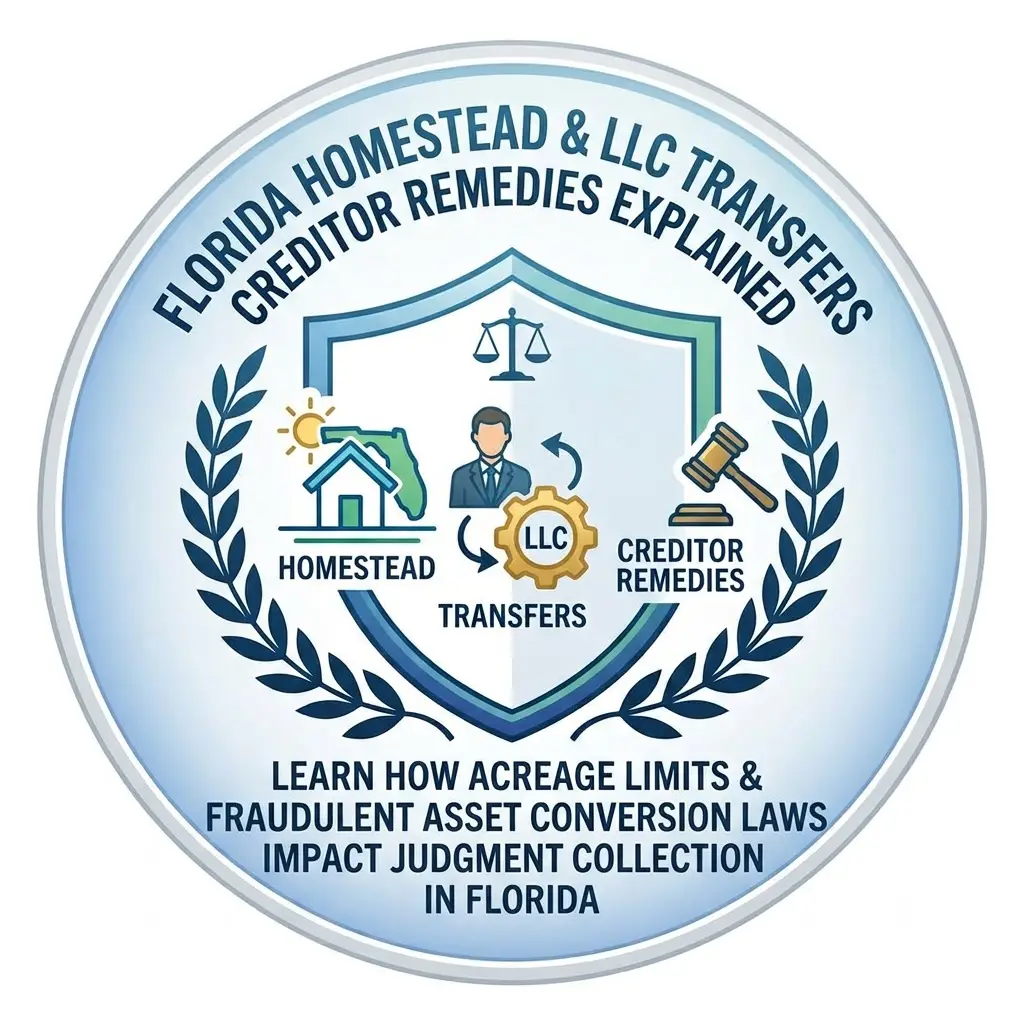
Every Florida lawyer who handles judgment enforcement has heard it before: “They can’t touch me. My house is homestead.” Sometimes that is true. Often it is incomplete. And sometimes it is dead wrong.
Florida’s homestead protection is powerful, but it is not magic. It comes from Article X, section 4 of the Florida Constitution, which protects qualifying homestead property from forced sale by most judgment creditors, subject to the familiar exceptions for taxes, obligations contracted for the purchase, improvement, or repair of the property, and labor performed on the realty. Just as important, the constitutional protection applies to property owned by a natural person, not property titled in an LLC or other business entity.
That last point matters more than many property owners realize.
The basic rule and the acreage cap
Under Article X, section 4, Florida homestead protection applies to up to 160 contiguous acres outside a municipality and up to one-half acre of contiguous land within a municipality, with the municipal protection limited to the residence of the owner or the owner’s family. Florida’s homestead exemption is often described as unlimited, but that is only true as to value. It is not unlimited as to acreage.
If the parcel exceeds the constitutional limit, the homestead exemption generally protects only the portion within the cap, and the surplus may be exposed to creditors. That means the creditor’s job is not always over when a debtor says, “It’s homestead.” Sometimes the next question should be, “How much land are we talking about?”
The LLC trap
Now for the move that causes real trouble.
A homeowner sees a claim coming, or already has a judgment outstanding, and decides to deed the house into an LLC for “asset protection.” Often the deed recites nominal or zero consideration. The owner assumes the home is now harder to reach because the individual no longer holds title.
In reality, the move can destroy the constitutional homestead protection because Article X, section 4 protects homestead owned by a natural person. Once title is placed in an LLC, the property is no longer held by a natural person, and the constitutional shield is no longer a comfortable place to hide.
This is the kind of planning that looks clever for about five minutes.
The statutes creditors should not ignore
The statutory overlay is where this gets even more interesting.
Section 222.29, Florida Statutes, provides that an exemption from attachment, garnishment, or legal process under Chapter 222 is not effective if it results from a fraudulent transfer or conveyance under Chapter 726. That statute does not rewrite Article X, section 4, but it reflects a strong legislative policy against using exemption law as a shelter for fraudulent transfers.
Section 222.30 goes further. It defines a “fraudulent asset conversion” as a conversion of an asset into exempt form made with the intent to hinder, delay, or defraud a creditor. The remedies are substantial. A creditor may seek avoidance of the conversion to the extent necessary to satisfy the claim, attachment or other provisional relief, an injunction, and any other relief the circumstances may require. If the creditor already has a judgment, the court may also allow levy and execution on the converted asset or its proceeds.
That language matters. It gives creditors a statutory basis to argue that when a debtor manipulates ownership or exempt status to frustrate collection, the court is not required to sit on its hands and admire the creativity.
What happens if the creditor avoids the deed
Suppose a homeowner transfers the homestead to an LLC, loses the homestead status because the property is no longer owned by a natural person, and the creditor later avoids the deed as a fraudulent transfer. Does the homestead exemption automatically spring back to life?
Florida law does not offer a clean, one-line answer. But sections 222.29 and 222.30 strongly support the argument that avoidance is not some empty procedural victory. The point of the remedy is to allow the creditor to reach the property or its proceeds to satisfy the judgment.
So even if title is restored to the individual, the attacking creditor has a strong argument that the court may grant relief against the asset itself, rather than allowing the debtor to say, “Thanks for unwinding my bad transfer, now my homestead is back and you still get nothing.” That is not how creditor remedies are supposed to work, and section 222.30 was plainly drafted to prevent exactly that kind of gamesmanship.
Practical takeaways for creditors
If you represent a creditor, and the debtor transferred a Florida residence into an LLC or insider entity for nominal consideration, do not stop at the word “homestead.” Check the current titleholder. Check the transfer date. Check the deed. Check the acreage. And then look hard at sections 222.29 and 222.30.
Those statutes give you a framework for asking the court not only to avoid the transfer, but also to grant meaningful relief against the property or its proceeds. In the right case, that can change the analysis from “the house is untouchable” to “the house is now part of the collection strategy.”
Practical takeaways for homeowners
For homeowners, the lesson is simple: if your goal is to preserve Florida homestead protection, casually deeding the property into an LLC is often the opposite of a solution. It can cost you the constitutional protection you thought you had and invite a fraudulent transfer fight that leaves the property more exposed, not less.
Florida’s homestead law is generous, but it was not written to reward title games. If the property is truly your homestead, protect it the right way. Once you start moving deeds around for zero dollars in the shadow of a creditor claim, you may be creating the very opening your creditor needs.
Discover more from A Lawyer In Florida
Subscribe to get the latest posts sent to your email.