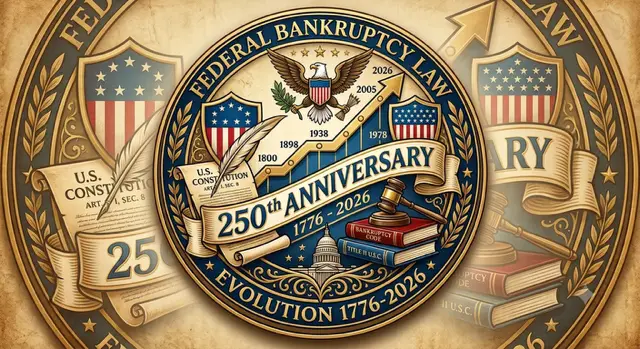
As the United States celebrates its 250th birthday, it is a good time to look at how American bankruptcy law changed along the way. The history is worth revisiting because it shows how the law moved from a harsh, temporary, and often improvised system into a more stable framework built to deal with business failure in an orderly way.
That evolution matters today. Bankruptcy law sits at the intersection of credit, risk, business planning, collections, and second chances. If someone wants to understand why the modern Bankruptcy Code looks the way it does, the best place to start is with the long stretch of trial and error that came before it.
Early Law Was Harsh and Unstable
In the colonial period and the early years of the republic, insolvency was often treated less like a business problem and more like a personal default that called for tough creditor remedies. Early American practice borrowed heavily from English models, including imprisonment for debt and surrender of property, with little real focus on rehabilitation.
The Constitution gave Congress the power to enact uniform laws on the subject of Bankruptcies throughout the United States, but that did not produce a lasting federal system right away.
The First Three Federal Experiments
Congress first acted in 1800. The Bankruptcy Act of 1800 was aimed mainly at merchants and commercial actors, and it reflected English practice in both structure and spirit. It was largely creditor-driven because cases were started through involuntary proceedings tied to specified acts of bankruptcy rather than through a debtor’s own voluntary filing.
The law was also temporary. It did not last long, and Congress repealed it in 1803 after dissatisfaction with how it was working and broader resistance to federal bankruptcy regulation.
The next federal effort came with the Bankruptcy Act of 1841. This was a meaningful change because it opened the door to voluntary bankruptcy and extended relief beyond the merchant class. In plain terms, a wider group of debtors could now seek federal bankruptcy protection on their own.
Even then, the system did not settle down. The 1841 Act lasted less than two years before Congress repealed it in 1843.
Congress tried again after the Civil War with the Bankruptcy Act of 1867. That statute was more comprehensive than its predecessors and covered both voluntary and involuntary cases. It also reflected a more developed federal administrative structure.
But the pattern repeated itself. Concerns about cost, delay, and abuse led to repeal in 1878, which meant that the country still did not have a bankruptcy system that endured.
1898 Finally Created a Lasting System
That changed in 1898, when Congress established a bankruptcy system that endured under the Bankruptcy Act of 1989.
The 1989 Act made the federal district courts courts of bankruptcy, gave them original jurisdiction over bankruptcy matters, and created the position of referee in bankruptcy to handle many day-to-day functions, subject to judicial review. In practical terms, the country finally had a durable national framework rather than another short experiment.
The 1978 Code Recast Modern Practice
That framework remained essentially in place until Congress undertook a major overhaul in 1978. The Bankruptcy Reform Act of 1978 created the modern Bankruptcy Code and reorganized the field into the statutory structure lawyers and business people know today.
This was more than a technical rewrite. It reflected a more modern understanding of insolvency as a legal and economic problem that needed a coherent national response.
Several features of current practice trace directly to that modern system. The automatic stay generally stops collection activity when a case is filed. Chapter 11 provides a structure for reorganization rather than immediate liquidation. Avoidance actions, including preferences and fraudulent transfers, remain central tools in the effort to maximize and fairly distribute value.
The modern system also reflects the long-recognized idea that bankruptcy law should give an honest but unfortunate debtor a meaningful fresh start, while still protecting creditor rights through court supervision and statutory priority rules.
Significant Amendments to the 1978 Code
The 1978 Code did not remain untouched. In 1986, Congress added Chapter 12 for family farmers after concluding that traditional Chapter 11 did not fit their seasonal income and debt profiles. Chapter 12 gave farmers a dedicated reorganization chapter with rules tailored to their circumstances, creating an early example of Congress using a specialized chapter to solve a practical mismatch between the existing Code and a specific group of debtors.
In 2005, Congress enacted the Bankruptcy Abuse Prevention and Consumer Protection Act (BAPCPA), which is often described as the largest overhaul of the system since 1978. BAPCPA introduced means testing for many consumer Chapter 7 cases, added mandatory credit counseling, and tightened discharge rules for certain debts, reflecting renewed concern about perceived abuse of the system and a recalibration of the debtor–creditor balance.
Subchapter V and the Small Business Shift
A more recent change is especially important for small business owners and professionals who do not live in bankruptcy court every day. In 2019, Congress enacted the Small Business Reorganization Act, which added Subchapter V to Chapter 11.
The point was to make small business reorganization more realistic by shortening timelines, reducing some of the cost, and simplifying parts of the confirmation process that made a traditional Chapter 11 too expensive for many smaller debtors.
The debt limit for Subchapter V did not stay constant. The CARES Act temporarily raised the eligibility ceiling to $7.5 million for qualifying cases filed during the pandemic period, and later legislation extended that higher amount through June 21, 2024.
That temporary increase expired in June 2024. For cases commenced on or after June 21, 2024, the applicable debt limit reverted to the original statutory framework as adjusted under 11 U.S.C. § 104, which the U.S. Trustee Program states is $3,024,725.
Why the History Still Matters
For readers who want a reliable visual overview of the larger history, the Federal Judicial Center’s bankruptcy history timeline is worth bookmarking: The Evolution of U.S. Bankruptcy Law: a time line.
The larger point is simple. Over 250 years, American bankruptcy law moved from temporary, uneven, and often punitive measures toward a more stable national system designed to manage failure, preserve value where possible, and allocate losses in an orderly way.
Creditors still have meaningful protections. Debtors still have important remedies. But the system is far more structured, predictable, and practical than the early republic’s short-lived experiments ever were.
Discover more from A Lawyer In Florida
Subscribe to get the latest posts sent to your email.