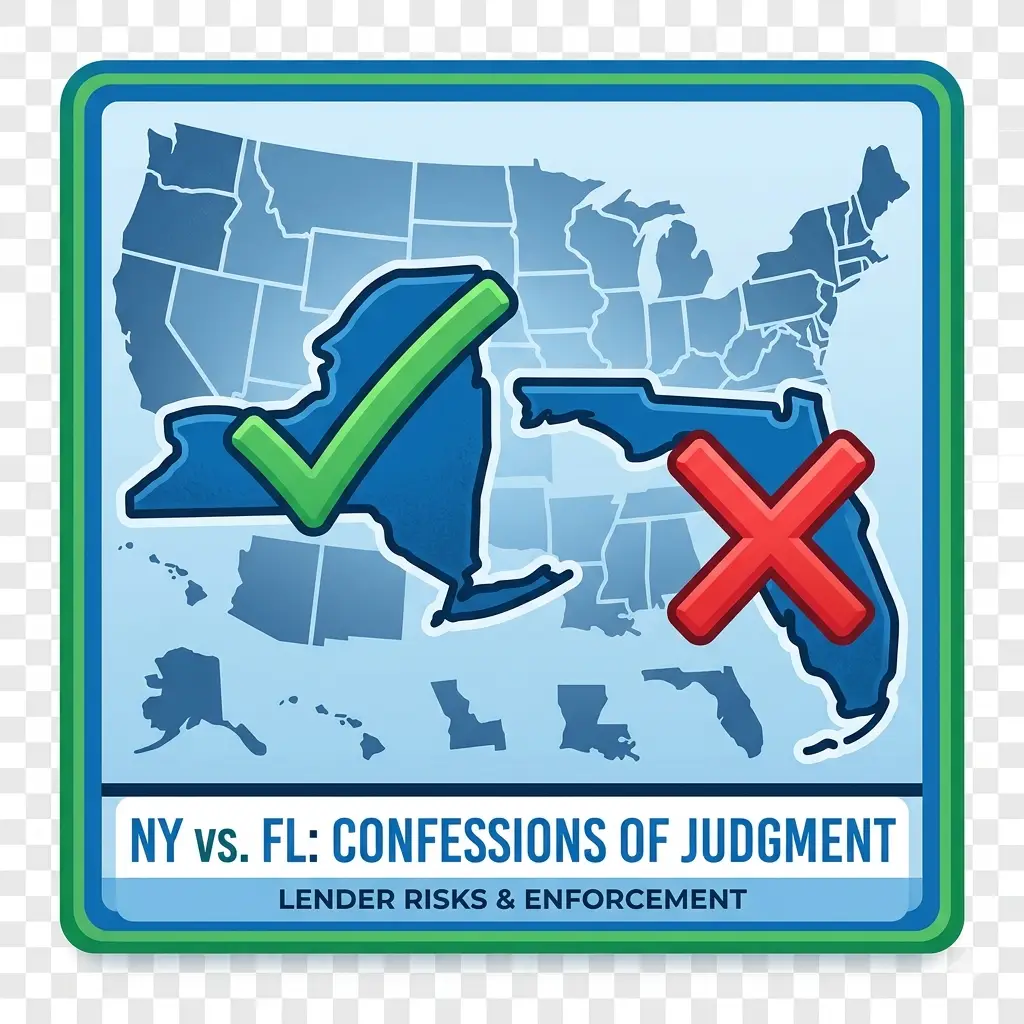
Confessions of judgment remain a powerful collection tool in New York, but they are no longer the broad, interstate hammer they once appeared to be. New York still permits them under CPLR 3218, yet the statute now limits their use to debtors who were New York residents or had their principal place of business in New York when the affidavit was executed. Florida, by contrast, continues to reject the device altogether, treating pre-suit waivers of notice and an opportunity to be heard as void under Florida Statute 55.05.
That split matters for creditors drafting loan documents and for debtors evaluating enforcement risk. A creditor using New York paper may still have a valuable shortcut in the right case, but a Florida-facing strategy usually has to rely on ordinary litigation, negotiated post-default settlements, and in some cases a stipulated judgment entered after suit has already been filed.
How the New York device works
Under CPLR 3218, a debtor may sign an affidavit for judgment stating the sum for which judgment may be entered and the facts out of which the debt arose. The affidavit is then filed with the county clerk, and judgment may be entered without the creditor first commencing a plenary action in the usual manner. That is the feature that has always made the New York confession of judgment so attractive to lenders and factors: speed, lower transaction costs, and immediate access to enforcement remedies once judgment is entered.
The procedure is deceptively simple. The creditor obtains a signed affidavit of confession that complies with CPLR 3218, files it in the proper county, and the clerk enters judgment in the amount authorized by the affidavit. Once entered, the creditor can move directly into ordinary post-judgment enforcement devices, including restraining notices, executions, levies, and other judgment-collection remedies available under New York practice.
That said, the statute is not as broad as it once was. Following the 2019 amendments, a confession of judgment may not be filed against a debtor who was not a New York resident and did not maintain a New York principal office at the time the affidavit was executed. The legislative response was aimed at curbing use of New York confession practice against out-of-state small businesses with little or no genuine New York nexus.
Why Florida rejects them
Florida Statute 55.05 declares null and void any agreement made before suit authorizing a confession of judgment or a prospective release of errors. The point is straightforward: Florida does not allow a debtor to sign away due process in advance and authorize a judgment to be entered without the ordinary protections of notice and an opportunity to be heard.
For that reason, a classic cognovit clause or advance confession provision in a Florida contract is not enforceable in Florida. Creditors who rely on them in multi-state documents often discover too late that Florida courts treat the issue not as a drafting defect, but as a public-policy problem.
Benefits and burdens
From the creditor’s perspective, the New York confession of judgment offers obvious advantages. It can eliminate the time and expense of a conventional lawsuit, create immediate leverage, and put the creditor in enforcement mode before the debtor has time to reposition assets.
From the debtor’s side, those same features are the danger. The debtor loses the benefit of ordinary pleading practice, discovery, and pre-judgment motion work, and may confront bank restraints or execution efforts before mounting any practical defense.
Florida’s prohibition flips the balance. It removes one of the most aggressive collection shortcuts from the creditor’s toolbox, but it also ensures that judgment follows a judicial process rather than a prepackaged waiver signed at origination.
A Florida workaround that is not really a workaround
There is, however, an important distinction under Florida law. Section 55.05 targets agreements made before the action is brought. That means a stipulated judgment negotiated after default, with counsel involved, and presented to the court through normal procedures is a very different animal from a pre-suit confession clause.
The difference is procedural and constitutional. In the post-suit setting, the debtor has already been served, has notice of the claim, has the opportunity to defend, and may choose to settle the pending litigation by agreeing to a payment arrangement and to entry of a final judgment upon defined future events. Because the court is acting within a filed case, and because the debtor is not waiving process before litigation even begins, the agreement avoids the core “before such action brought” problem addressed by section 55.05.
A common structure looks like this. First, the creditor files suit in Florida and obtains service. Second, after default or during settlement discussions, the parties execute a written settlement agreement with a payment schedule, default triggers, notice and cure provisions, and a stipulated final judgment consistent with the claims asserted in the complaint. Third, the parties present the agreement to the court by joint motion, asking either that the stipulated judgment be entered immediately with execution stayed while payments are made, or that the court retain jurisdiction to enter or enforce the stipulated judgment upon a later default shown by motion and affidavit.
If the debtor later misses payments and the cure period expires, the creditor then proceeds through standard procedures in the pending case. That usually means filing a motion to enforce settlement or a motion for entry of the stipulated final judgment, supported by the agreement, proof of default, and proof that contractual notice requirements were satisfied. The court then enters judgment in the ordinary course, rather than through a private pre-suit authorization to confess judgment.
This is not a confession of judgment under another name. It is a litigation settlement mechanism, and that distinction matters in Florida.
Can a New York creditor obtain consent to New York jurisdiction anyway?
A separate but related question is whether a New York creditor can require a foreign debtor to waive jurisdictional objections and consent to suit in New York even if the debtor would not otherwise fall within New York’s long-arm statute. Forum-selection and consent-to-jurisdiction clauses are generally enforceable, and parties commonly use them to eliminate personal-jurisdiction fights.
Still, consent is not magic. It may waive a personal-jurisdiction objection, but it cannot rewrite a statute that expressly restricts a remedy. So even if a foreign debtor agrees in the loan documents to New York venue and New York jurisdiction, that consent does not restore access to a New York confession of judgment when CPLR 3218’s residence or principal-office requirement is missing.
The practical answer is that the creditor may still be able to sue in New York through ordinary litigation if the clause is otherwise enforceable and no other statutory limitation blocks the action. What the creditor probably cannot do is transform a nonqualifying foreign debtor into an eligible New York confession-of-judgment debtor merely by contract language.
Discover more from A Lawyer In Florida
Subscribe to get the latest posts sent to your email.